

WEB DEVELOPMENT · ECOMMERCE · SEO · DATA · AUTOMATION
I fix the complicated parts of websites and eCommerce.
WooCommerce problems. Product data. Imports. Scraping. Automation. Technical SEO. The awkward jobs that don’t fit neatly into a plugin.
HOW I THINK
I learned this by solving problems in my own businesses.
I learnt most of this because I was running my own eCommerce businesses and kept hitting problems that needed solving.
Products needed importing. Prices needed changing in bulk. Stock needed managing. Supplier data needed cleaning up. Marketplaces needed feeding. Websites needed improving. And manual jobs that worked at a small scale stopped making sense as the businesses grew.
So I learnt how to solve them. First because I needed to, then because that became the part of the work I was best at.
That’s still how I work now: understand the business problem first, then use whatever combination of development, data, SEO or automation makes sense.

WOOCOMMERCE & ECOMMERCE
Managing 100 products is one thing. Managing 10,000+ is a different problem.
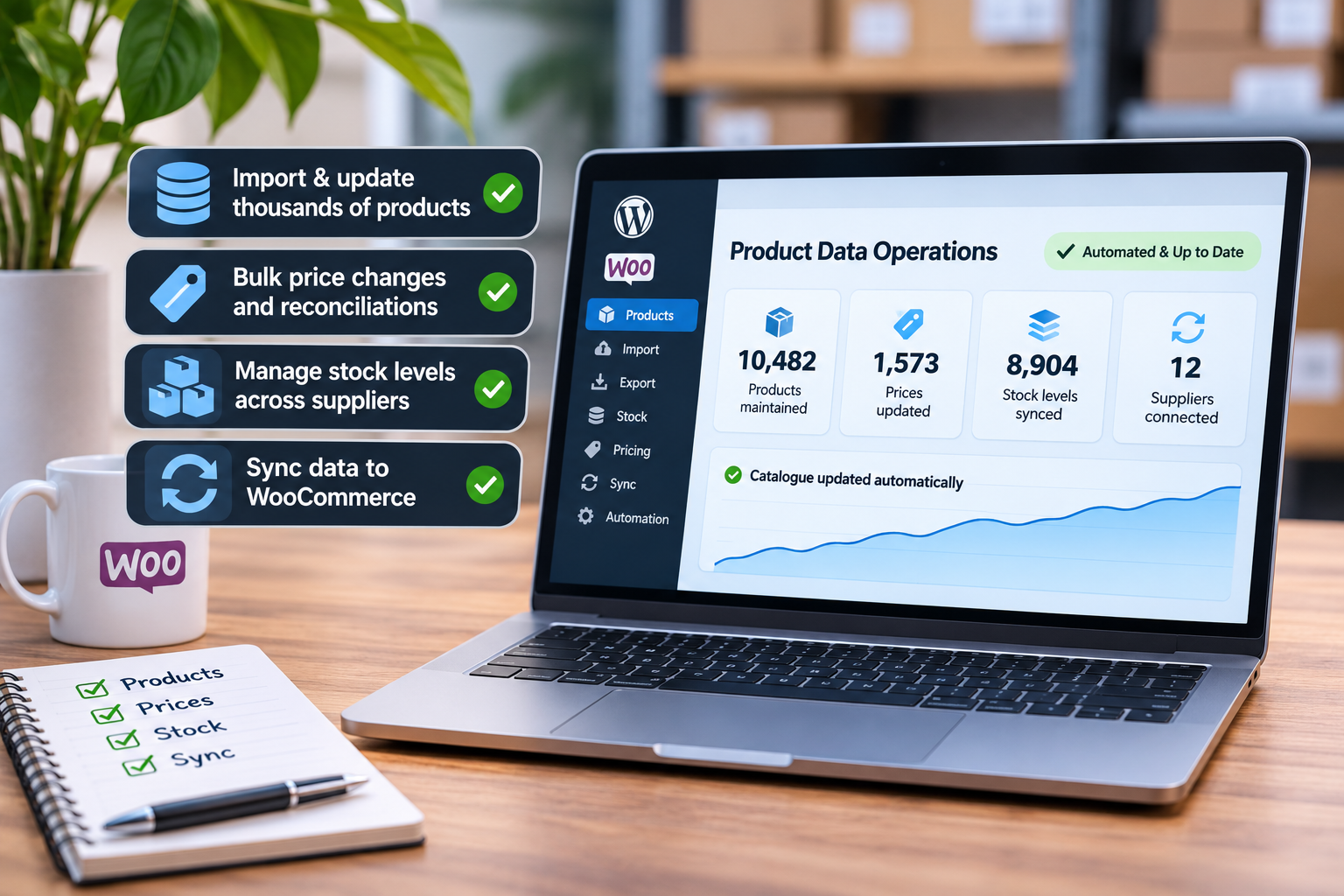
I’ve managed catalogues with more than 10,000 products across 12 different manufacturers. Prices change. Stock changes. Products are added and discontinued. Supplier files arrive in different formats, with different identifiers and different levels of accuracy.
I build and fix the systems around WooCommerce that make that manageable: bulk price changes, stock updates, product matching, imports, exports, supplier data, integrations and custom workflows.

DATA & AUTOMATION
If you’re repeating the same job, there’s normally a better way.
I’ve spent years finding quicker ways to handle supplier spreadsheets, thousands of price changes, stock checks, catalogue updates, product imports, scraping and keeping large sets of product data in sync.
Sometimes the answer is PHP. Sometimes it’s a script. Sometimes the hard part is simply matching supplier SKUs, manufacturer codes and existing products reliably before anything gets updated.

SCRAPING & TECHNICAL PROBLEMS
The information exists. It’s just in completely the wrong place.
That’s where scraping, APIs, custom code and a bit of lateral thinking become useful.
I’ve used them to collect thousands of products, compare supplier and manufacturer information, match records, clean data and turn awkward sources into something that can actually be imported and managed.
It’s also why I like jobs that don’t fit cleanly into a standard web-development brief. They’re often the ones where removing the manual work makes the biggest difference.
REAL ECOMMERCE WORK
This isn’t theory. I’ve had to manage this stuff at scale.
My experience comes from dealing with the same catalogue problems eCommerce businesses run into every day: supplier data, changing prices, stock, imports, discontinued products and information that needs keeping accurate across thousands of SKUs.
I’ve scraped and imported thousands of products, matched supplier and manufacturer codes, checked stock, processed bulk price changes, cleaned catalogue data and kept large product ranges manageable. That’s the experience I bring when a catalogue has outgrown the way it was originally being maintained.
HOW I WORK
Show me the problem first.
What’s actually wrong?
Not which plugin somebody thinks you need. What is slow, broken, expensive or annoying?
What’s the shortest route?
Code if it needs code. Automation if it repeats. A simpler process if technology isn’t actually the answer.
Can it keep saving time?
I prefer systems that remove repeated work rather than clever fixes that create another thing to maintain.
MY OWN TEST LAB
MostlyPens is where I have to live with my own decisions.
I started it because I missed making physical things, but it’s also useful having my own eCommerce business to experiment on.
Product design, printing, WooCommerce, Amazon, image generation, catalogue automation and SEO all end up meeting in the same place.
There’s no client hand-off. If I make something awkward, I’m the one who has to use it tomorrow.

YOUR TURN
Tell me what’s taking too long.
Or what’s broken. Or what somebody told you would need to be done manually.